Rescue
overview
Rescue is a systems-driven design project focused on eliminating the inhumane practice of manual scavenging. By exploring the interconnected relationships between products, systems, and services, the project aims to develop a modular, scalable solution that improves working conditions, prioritises safety, and restores dignity to sanitation workers. The goal is to create a more inclusive and humane sanitation ecosystem through thoughtful, system-level design.


year
2021
role
Experience Desinger
UI Designer
Concept Design
institute
National Institute of
Design, Harayan
Problem Area
Despite legal prohibitions, manual scavenging continues to persist in India, exposing sanitation workers to hazardous working conditions, life-threatening risks, and preventable deaths. Deeply rooted in caste-based discrimination, the practice perpetuates social exclusion and denies workers basic dignity and safety. The challenge is to rethink existing sanitation systems to eliminate hazardous manual intervention, improve worker safety, and enable a more dignified and equitable working environment.
About Manual Scavenging
Manual scavenging is "manually cleaning, carrying, disposing of, or otherwise handling, human excreta in an insanitary latrine or in an open drain or sewer or in a septic tank or a pit". Manual scavengers usually use hand tools such as buckets, brooms and shovels. The workers have to move the excreta, using brooms and tin plates, into baskets, which they carry to disposal locations sometimes several kilometers away. They rarely have any personal protective equipment. The work is regarded as a dehumanizing practice.
India proactising manual scavenging inspite of the act 1993, act 2013 and act 2020 against it as no effective measures are taken to put these acts in order.
920
Deaths (1993 - 2010)
110
Deaths (2019)
62,904
Manual Scavengers (2013 - 2020)


Data Categorising and Mind Mapping
Brainstorming to put all data about Manual scavenging amongst the group and as research as a starting point to make the system map and categorizing it to get a clearer idea of it as whole.
Visually organizing and linking all the information to understand the relationship and flow between the pieces of the whole. Mind Map is refined into a causal loop format that represents the cause-and-effect relationships between different components of a system.


Integrated Mapping and Actor Mapping
Integrating causal loop and actor map in such way that it is simple to understand by people and then see if actors could relate to it or add to it.
Actor mapping helps understanding the connection between all the actors of the system and how they affect the role of their fellow actors.


Theory of Change
This tool is used to map the imaginary journey of problem and trace if the aspired solution has any loop holes. These are some loops, each one starts at a yellow post aid and ends with the red post aid. It helps us keeping in mind the major drawbacks that could come with some of the solutions and thus would make the problem solving efficient.

Day in a life of Manual Scavenger

User Interviews


Ecocycle Mapping
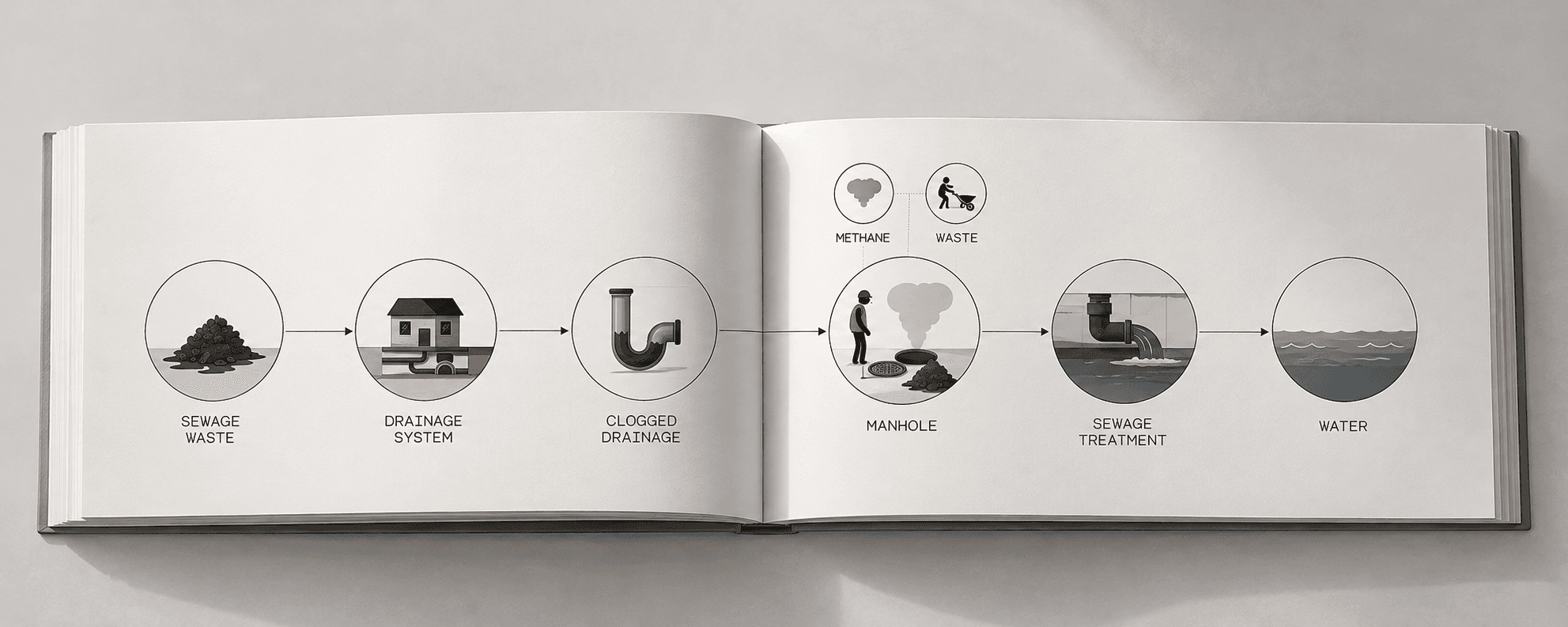
Giga Map

Rescue
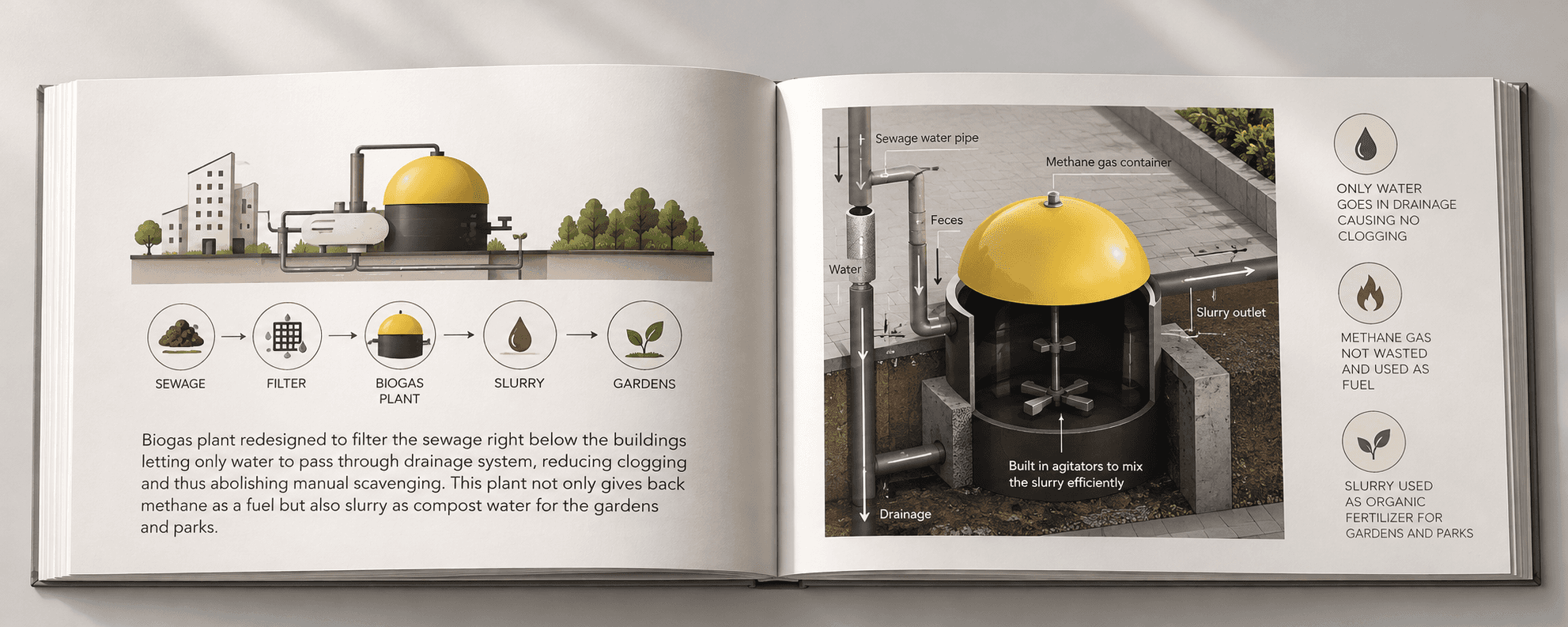
Rescue is an integrated design solution that combines systems thinking with product and service design concepts to abolish the inhumane and caste-biased practice of manual scavenging in India. This integrated design is not only sustainable but also eco-cyclic in nature, offering dignity to the underprivileged castes while improving their health and livelihood.
Product Design Concept
The redesigned biogas plant utilizes methane, which would otherwise be wasted, to produce fuel. It also filters water in drainage systems, reducing blockages in drains, and produces slurry for healthier gardens and parks. The solution is grounded in the principle of giving back to nature, creating an eco-cyclic and sustainable system.
Service Design Concept
Rescue is an integrated design solution that combines systems thinking with product and service design concepts to abolish the inhumane and caste-biased practice of manual scavenging in India. This integrated design is not only sustainable but also eco-cyclic in nature, offering dignity to the underprivileged castes while improving their health and livelihood.

gauravilad.design@gmail.com
Bengaluru, Karnataka
@2026